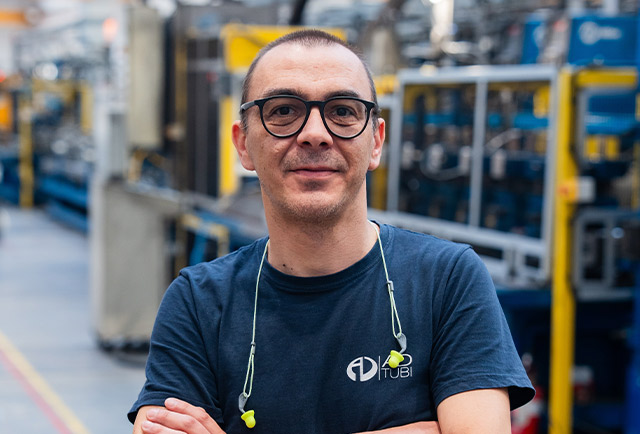
One Minute With… Matteo Cappelletti
- 1 July 2026
Behind every safe, compliant, and sustainable process lies continuous work involving analysis, prevention, and improvement. In this edition of One Minute With…, we meet Matteo Cappelletti, QHSE Manager at A.D. Tubi Inossidabili. We spoke with him about safety, compliance, and how regulations and procedures can be transformed into practical tools that support both people and business.
Name and role
Matteo Cappelletti, QHSE Manager.
How long have you been working at A.D. Tubi Inossidabili, and how did your career begin?
I have been working at A.D. Tubi since February 2013. My first assignment, which still represents an important part of my current responsibilities, was to develop the integrated Health, Safety and Environmental Management System in accordance with the BS OHSAS 18001 and ISO 14001 standards, with the goal of obtaining the company’s first certifications, achieved in 2014. In the following years, I also took on quality-related responsibilities, managing the Quality Department until 2023. I joined the company to support compliance with health, safety, and environmental regulations, particularly Legislative Decree 81/08 and Legislative Decree 152/06, helping to build an increasingly structured and robust culture of compliance.
What does managing compliance in a company mean in practical terms?
It means ensuring that the company complies with all the rules governing its activities: from national legislation and industry standards to internal procedures and international standards such as ISO 9001, ISO 45001, and ISO 14001 certifications. In other words, it means creating the conditions that allow the organization to operate safely, responsibly, and sustainably over time.
Which part of your job requires the most experience and attention?
The most challenging aspect is assessing actual risk and managing the so-called “grey areas.” Checking a procedure or reviewing documentation is a technical task; understanding where the company is truly vulnerable and finding the right balance between regulatory compliance and operational needs requires experience, analytical skills, and a deep understanding of the business environment.
When can an Integrated Management System be considered truly well-managed?
When it stops being a collection of documents created merely to pass an audit and becomes a practical tool that supports daily operations. An effective system integrates Quality (ISO 9001), Environment (ISO 14001), and Occupational Health & Safety (ISO 45001) into genuinely interconnected business processes, avoiding duplication and simplifying activities. In this way, it becomes a true driver of continuous improvement rather than a simple bureaucratic requirement.
What details really make a difference in your work?
The ability to design processes and procedures by putting yourself in the shoes of the people who will apply them every day. If a system makes their work easier, then it is truly effective. This is what I call organizational empathy. From a health and safety perspective, it is also essential to use leading indicators that help prevent problems before they occur, such as monitoring training activities, corrective actions, or near-miss reports. These may seem like small details, but they are extremely valuable for continuously improving the system.
What is the most important skill you have developed over the years?
The most important skill I have acquired—and continue to develop—is the ability to promote a culture of safety based on listening, positive influence, and empathy. Knowing the regulations is essential, but it is not enough. Over time, I have learned that safety cannot be perceived as an obligation imposed from above; it must become a shared value. The goal is not simply to be compliant, but to create an environment where people look after themselves and one another, even when no one is watching.
How important is experience compared to technical training in your role?
Both are fundamental, but experience carries significant weight. If we were to make a realistic assessment, experience accounts for about 70% of what is needed, while technical training represents the remaining 30%. Training—such as the RSPP qualification, a degree focused on industrial hygiene, and ongoing professional development courses—provides the regulatory and technical foundations required for the role. Experience, however, teaches you how to apply those principles in the day-to-day reality of a manufacturing company. It means finding practical, sustainable, and gradual solutions while taking production requirements, timelines, and available resources into account.
What would you say to someone considering a career in your field?
You will never be the main character of the story! When you do an exceptional job in HSE or compliance, the best results are reflected in the absence of problems: no accidents, no penalties, no emergencies. It is a profession that works behind the scenes, yet it has an enormous impact on people’s lives and on the long-term stability of the company. It is a career that requires passion, balance, and determination, but it also brings great satisfaction. If every employee returns home safely to their family at the end of the day, part of that achievement belongs to you. You must be ready to continuously balance operational needs with regulatory requirements, always maintaining a constructive and solution-oriented mindset.
What are you most proud of in your work?
I am proud of having helped increase awareness of the value of safety and compliance within the organization. Today, it is becoming increasingly clear that safety, ethics, and respect for regulations are not costs or obstacles to business; they are essential conditions for ensuring sustainable, long-term growth. That cultural shift is probably the achievement I am most proud of.